
Burglary-resistant technology
Modern technology makes it possible to protect windows and doors against burglary effectively.
Resistance classes
Resistance to burglary results from the construction of the window and from the materials used to make it. At present the basic document classifying the resistance of a window is the standard ENV 1627:2006, which divides windows into 6 groups, where the sixth class is the highest level of protection.
Depending on the type and arrangement of the hardware in the window, it may have different classes of resistance to burglary. The 3 classes of solution most popular on the market are:
- WK1 – a window that cannot be forced using muscle power alone (without the use of tools). All the corners of the timber window are fitted with elements of increased resistance to burglary. Steel security striker plates are used. The hardware has a lockable handle, which prevents the hardware from being deliberately moved, Hoppe Secustic. The fixing is covered with an anti-drill plate. A key-lockable handle is recommended.
- WK2 – a window that cannot be overcome for 3 minutes using simple tools (screwdriver, pliers, pincers etc.). The corners and espagnolette gears are provided with stainless steel mushroom cams of increased security. The hardware strengthens all the corners of the window at two points and the central points of the sash profile. Burglary-resistant glass of class P4.
- WK3 – a window that will not yield even to a metal crowbar for at least 5 minutes. Very densely spaced top-quality locking points – two in every corner, or four in larger windows. At least two locking points on each side of the profile. Sophisticated self-latching mechanisms instead of simple single-pin or mushroom-cam hardware. It is also worth using a counter-rotating central locking mechanism, which works on an opposing principle – when an attempt is made to lever out one roller, the other tightens in the striker plate with exactly the same force.
It must be remembered that the resistance of burglary-resistant windows does not result only from the hardware used in these windows. All the elements of the construction of a timber window are important.
Modern technology
When deciding on timber windows with additional protection, it is worth choosing additional elements for securing the windows.
Magnetic contact
A simple and effective sensor detecting the opening of windows. A magnetic contact can also be used in external doors. It forms part of an alarm system or of access control.
Using a magnetic contact provides protection as early as the moment the door or window is opened, unlike sensors which raise the alarm only inside the building. Opening a secured window breaks the electromagnetic circuit, which triggers the alarm.
Magnetic contacts are fitted at the stage of manufacturing the timber windows.
Integrated magnetic contact
A magnetic contact integrated with the perimeter hardware works in the same way as an ordinary magnetic contact in a window, but even slight interference with the hardware or the handle is enough to trigger the alarm.
P4 glass
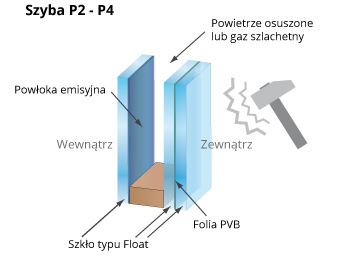
The double-glazed unit is built, from the outside, of a 4 mm pane, four films 0.38 mm thick and a 4 mm pane. Such a solution provides greater resistance to burglary.
The PVB film holds the glass in place: in the event of breakage the fragments remain stuck to the film.
Security cylinders
The timber external doors we manufacture are fitted as standard with two security cylinders of class “C”. They are distinguished by additional security features such as: hardened pins, anti-drill protection, a ring protecting against the cylinder being pulled out or snapped, and features locking the cylinder in the event of an attempted break-in by inserting a different key.
Additional keys can be cut only with the security card supplied with the cylinder.