
What to be guided by when choosing an entrance door?
The entrance door is the calling card of a house. Besides decorative functions it also serves other important roles, among others it is responsible for the thermal insulation of a building. Instead of deciding to buy a random door, it is better to analyse its technical performance and choose the best product in terms of quality. The post below will help you decide which external door is worth having.
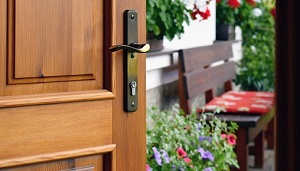
Durability, thermal insulation and sound absorption
Entrance doors are produced from various materials, including: timber, aluminium, steel and PVC. Timber doors made of pine, meranti and oak have very good performance in terms of strength. In terms of thermal insulation, doors of timber have no equal. Their thermal transmittance Ud is very low and can be as little as 1.1 – 1.4 W/(m²∙K). This means that timber entrance doors will work excellently in energy-efficient and passive houses. The advantages of timber also include good acoustic insulation. Steel doors are heavy and durable, but not as “warm” as timber doors. Like aluminium doors, they require special insulation that will protect a house against heat loss. Metal doors have one more drawback — they muffle sound poorly. Doors of PVC are light and provide good thermal insulation, but they can deform under the influence of high temperature.
Security
One of the most important functions an external door should serve is protection against break-ins. A good security door can be recognised by a range of safeguards, such as: security handles, escutcheons and cylinders, hinges of reinforced construction, anti-lift blocks and locks bolting the door in at least 3 places. Doors of class RC2 have enhanced protection against break-ins.
Design
The entrance door draws the eye, which is why it should be well matched to the architectural style of a house. The colour of the door we decide on must harmonise with the facade of the house, the window joinery and the roof. An interesting solution used in external doors is glass inserts, which light the hallway and serve decorative functions, giving them an individual character.