
What are the differences between rebated and flush-fitting doors?
Furnishing a home is without the slightest doubt an opportunity to learn a whole mass of new terms and to look more closely at elements to which one has not previously paid much attention. An excellent example here is the rebate in a door, which everyone probably knows well, though hardly anyone can name it correctly. What is a rebate and what is the difference between doors with a rebate and those without one?
What is the rebate in a door?
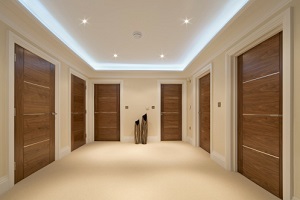
A rebate is nothing other than a small recess running along the top and side edges of a door. The leaf then overlaps the frame to some extent. This solution is very widely known – rebated doors dominated the door joinery market for many years. Only relatively recently did they gain competition in the form of flush-fitting doors, that is ones that lack this characteristic recess. When closed they disappear, as it were, into the frame. From this single, seemingly very cosmetic and insignificant difference, however, many further ones follow, in terms of both appearance and functionality.
The rebate and the appearance of a door
One of the main factors deciding the choice of a door is its appearance. The presence of a rebate or its absence is of considerable importance in this matter. Above all it is today treated as a certain indicator of style – doors with a rebate are perceived as a classic, traditional solution, even if their design suits contemporary trends better. Flush-fitting doors, in turn, are usually taken to be a modern solution, fitting into the currently fashionable currents of minimalism or industrial style. One can also quite often meet the opinion that doors with a rebate are visually lighter. This is caused by the fact that they stand out more clearly from the surface of the wall, whereas the surface of rebated doors goes, as it were, into the wall and they may therefore appear more massive and heavier. This matters when choosing doors for rooms of small area – in small rooms heavy doors can dominate the space and make it seem even smaller than it really is. This is felt particularly strongly if the door is dark in colour, because it is precisely such colours that contribute to a space being perceived as smaller. On the other hand, by using doors without a rebate the floor area can be visually increased, which works well for example in narrow corridors.
Open or closed?
The presence of a rebate or its absence matters for the appearance of a door also depending on whether it is closed or open. In rebated doors it is possible to conceal the lock completely when they are closed; on the other hand their hinges remain visible. In doors without a rebate the lock is visible, but they can be fitted with hinges that are visible only at the moment of opening. That is why they generally look better in rooms that are usually kept closed – for example in studies. It is worth taking this into account when planning the decoration of a home. If you know that the doors to particular rooms will tend to be open (e.g. in order to light a corridor without windows), a door with a rebate will be the more attractive solution.
With a rebate or without?
As with every solution, a rebate in a door or its absence may have its pluses and minuses. Besides appearance, which is a strongly individual question, attention should also be paid to certain functional aspects of both solutions. A significant drawback of flush-fitting doors is that they do not provide as effective acoustic insulation, which is caused by the presence of a narrow, uncovered gap between the leaf and the frame. Moreover, their maximum opening angle up to 90 degrees, which can be problematic when moving larger objects. On the other hand they are more durable, less exposed to damage and dirt, and fitting them with a magnetic lock means that their opening and closing will be very quiet.
As can be seen, then, there are a great many differences resulting from the presence of a rebate in a door or its absence, and they are not limited solely to appearance. We know that the choice between these options can be difficult, so we invite you to contact us about it. We will gladly help in choosing the right solution and explain any doubts.